Keys to Achieving a Good Life: Faith, Dhikr, and Contentment
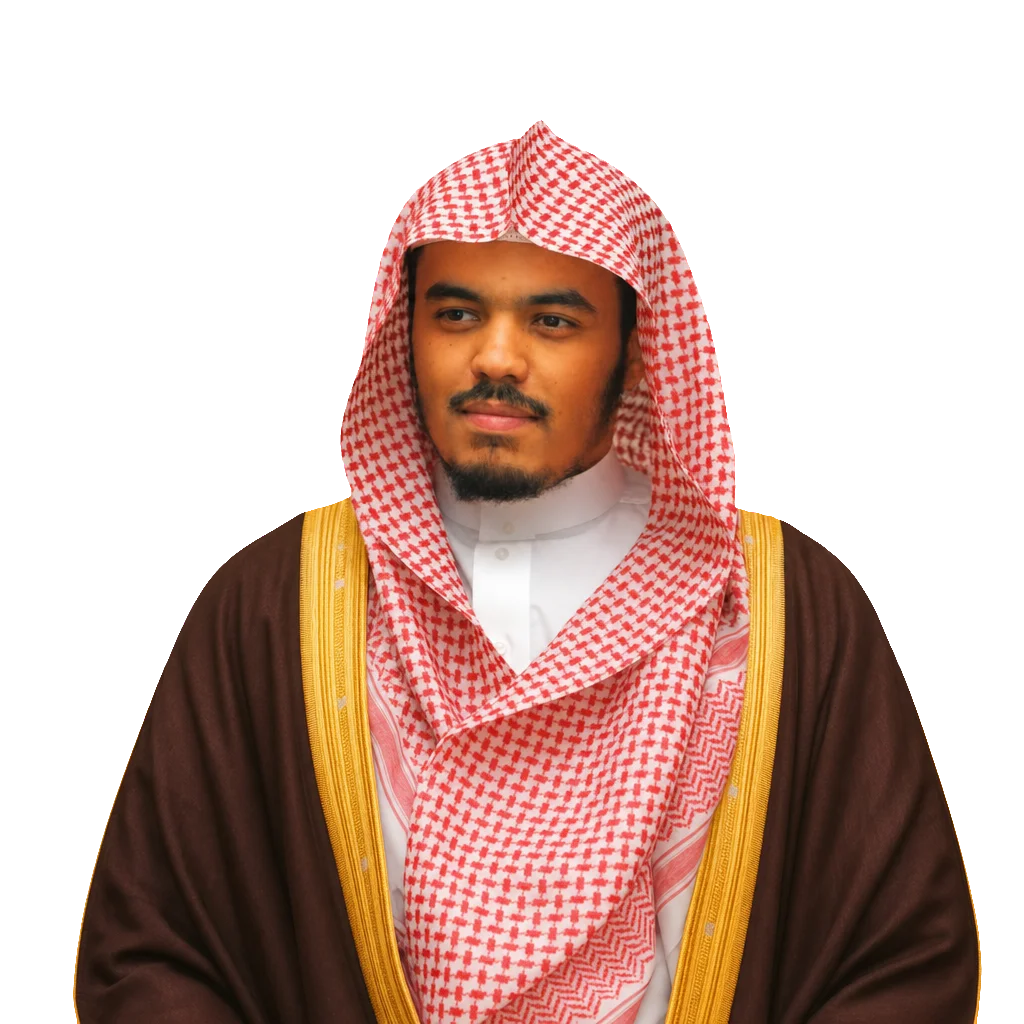
A comprehensive lecture on how a believer attains a peaceful and reassuring life in this world and the Hereafter. The talk outlines key spiritual foundations, including fulfilling Tawhid, maintaining constant remembrance of Allah ﷻ, finding contentment with divine decree, choosing righteous companions, and reflecting upon the Quran under the guidance of scholars.
...of knowledge.
How could he not be, when our guest is more famous than a beacon on a hilltop, and the sun in the full light of day?
Our guest is this voice that you heard, which reached your ears...
...and echoed in the halls of this blessed mosque.
Yes, he is an Imam and Khateeb of the Haram.
The Imam and Khateeb of the Grand Mosque in Makkah, His Eminence Sheikh Dr. Yasir bin Rashid Al-Asiri.
Welcome to the voice we have grown fond of, and the countenance we have known.
Welcome to him whose companion is the mihrab of the Sacred Mosque, and whose confidant is its minbar.
On behalf of the Naval Forces General Staff, represented by the Eastern Fleet Command and its commander,
His Excellency Rear Admiral Sajid bin Fahd Al-Alizi and all fleet officials,
as well as this blessed gathering who attended even from outside the fleet,
we welcome His Eminence the Sheikh and reiterate our warm welcome.
Welcome, again and again, upon the arrival of His Eminence the Sheikh.
May Allah reward you for accepting the invitation.
May Allah make us among those who listen to the Word and follow the best of it.
And now, we invite His Eminence to speak, with our thanks and prayers for his reward.
“In the name of Allāh, the Entirely Merciful, the Especially Merciful.”
“[All] praise is [due] to Allāh, Lord of the worlds -” (Quran 1:1-2)
Who knows the measure of the seas, the number of leaves on the trees, and the number of raindrops,
and all that over which the night grows dark and the day shines bright.
I bear witness that there is no god but Allah, alone, without partner,
and that Muhammad ﷺ is His servant and Messenger, the chosen Prophet, and upon his family and pure companions,
and all who follow them in righteousness until the Day of Settlement.
To proceed: I greet you with the greeting of Islam.
May the peace, mercy, and blessings of Allah be upon you.
I ask Allah ﷻ that, just as He has gathered us in this blessed mosque,
He gathers us together under the shade of His Throne, facing one another on couches, in Gardens...
“Indeed, the righteous will be among gardens and rivers,”
“In a seat of honor near a Sovereign, Perfect in Ability.” (Quran 54:54-55)
I also ask Him, Glorified and Exalted, to grant us beneficial knowledge and righteous deeds,
and I ask Him, Glorified and Exalted, to grant us such understanding of Him and His Messenger ﷺ
as will elevate us to the rank of the truthful,
the martyrs, and the righteous — "and excellent are those as companions."
At the outset of this lecture,
I offer supplications for our leaders in this blessed state,
asking Allah ﷻ to reward them abundantly on our behalf,
led by the Custodian of the Two Holy Mosques, King Salman bin Abdulaziz,
and His Royal Highness the Crown Prince, Prince Mohammed bin Salman,
may Allah protect them,
for all they provide and the great attention
and utmost care they devote to all that would
educate the people,
and to enlightening mankind on what brings them
benefit in their religion and worldly life,
and for all the great efforts they exert in service to Islam and Muslims.
I ask Allah ﷻ to perpetuate their honor, preserve this land,
and safeguard its security, safety, prosperity, and stability,
and make it lofty and proud until the Day of Judgment.
Furthermore, I extend my heartfelt thanks to the Minister of Defense,
His Royal Highness Prince Khalid bin Salman, may Allah protect him, for his great efforts
in serving this sector, this blessed ministry,
and for their efforts in facilitating these lectures that educate and enlighten people.
May Allah place that on the scale of their good deeds.
Our thanks also go to His Excellency
Vice Admiral Mohammad Al-Ghareebi,
Commander of the Naval Staff,
for his great efforts in facilitating such gatherings.
Thanks also to His Excellency
Rear Admiral Sajid
Al-Anezi, Commander of the Eastern Fleet,
may Allah grant him success, for his efforts,
providing this opportunity,
warm hospitality, and gracious reception,
and for everything we have seen during this blessed visit.
I ask Allah ﷻ to place that on the scale of his good deeds, along with all those working with him in all
departments and sectors,
including the Department of Religious Affairs.
May Allah reward them well for their efforts, especially the head of this department,
His Eminence Brigadier Sheikh Khalid Al-Mane'a, may Allah grant him success.
I ask Allah to reward him and those working with him in this department.
Now, I begin this lecture,
which I have titled 'The Good Life'.
I say, seeking the help of Allah ﷻ:
A good life is the desire of every human and
the goal of every rational person in every age,
across different cultures, societies, and religions,
especially in this era where worries, sorrows,
distress, and delusions have multiplied.
There is no way to achieve a good life except by attaining faith,
which is declaration by the tongue,
which is belief in the heart,
statement on the tongue, and action with the limbs.
So whoever fulfills tawhid and fulfills faith...
is given glad tidings of a good life in this world and in the Abode of Permanence.
And a good life does not mean indulging in desires,
rather, it means
gladness of heart, peace of conscience, and peace of mind
that Allah ﷻ instills in a person's heart,
so he lives reassured, content, and at ease.
Allah ﷻ says:
“Those who have believed and whose hearts are assured by the remembrance of Allāh. Unquestionably, by the remembrance of Allāh hearts are assured."” (Quran 13:28)
by devoting one's heart to Allah, and turning with one's whole being to Him,
As Ibn al-Qayyim (RH) said when describing the I'tikaf of the Prophet ﷺ
in late Ramadan, he said that he observed I'tikaf to devote his heart to Allah.
Devoting the heart to Allah means turning every detail of your life toward Allah.
This is among the greatest divine guidance Allah ﷻ grants to whomever He wills,
enabling them to realize this sublime meaning in this life.
This provides the primary path through which we can attain the good life.
Among the essential paths and key means to achieve this is realizing Tawheed,
and fulfilling true servitude to Allah ﷻ.
“Say, "Indeed, my prayer, my rites of sacrifice, my living and my dying are for Allāh, Lord of the worlds.” (Quran 6:162)
...Lord of the worlds.
That you direct your life, in all its details, to Allah ﷻ,
for humanity was not created, nor was creation created, except to fulfill servitude to Allah ﷻ.
Allah ﷻ said, as is well known to your noble selves:
“And I did not create the jinn and mankind except to worship Me.” (Quran 51:56)
You turn to Allah with your heart in true devotion,
so that everything you do in your life is seeking the pleasure of Allah ﷻ.
For Tawhid gathers the scattered heart. By nature, the heart tends to become divided,
pulled apart by worries, sorrows, and competing concerns in this life:
wealth on one side, family on another, work, health, and relationships on others.
If a person turns to these worldly concerns and abandons Tawhid,
their soul becomes fragmented and their heart is lost.
Some turn to wealth, becoming a slave to money; others turn to status,
becoming a slave to position;
and others turn to luxury, becoming a slave to luxury.
Allah ﷻ depicted this state for us, and the Prophet ﷺ termed it a form of servitude.
He ﷺ said: "Miserable is the slave of the dinar, the dirham, and fine clothes." He ﷺ called it servitude,
Allah ﷻ depicts this person's condition. He ﷻ says:
“Allāh presents an example: a man [i.e., slave] owned by quarreling partners and another belonging exclusively to one man - are they equal in comparison? Praise be to Allāh! But most of them do not know.” (Quran 39:29)
"...quarrelsome, and a man belonging entirely to one man. Are they equal in comparison?"
Allah ﷻ illustrates for us the case of the monotheist and the non-monotheist.
The monotheist's heart is with Allah ﷻ;
he obeys Allah's commands, adheres to them, and refrains from what Allah forbade,
and goes wherever Allah ﷻ commands him.
His heart obeys Allah's command; he has only one Lord.
Whereas the other sways to the right at times, and to the left at others;
one orders him to do something, and another orders him to do something else, leaving him torn.
Thus, Allah ﷻ contrasts the monotheist and the non-monotheist:
the monotheist is like the man belonging entirely to one man,
whereas the other is a man belonging to quarrelsome partners.
Then Allah ﷻ says:
“Allāh presents an example: a man [i.e., slave] owned by quarreling partners and another belonging exclusively to one man - are they equal in comparison? Praise be to Allāh! But most of them do not know.” (Quran 39:29)
Reminding people of Tawhid is among the most essential matters, and it is what our scholars have followed,
and what the prophets brought before that.
And the religion that Allah ﷻ revealed is Islam.
“And We certainly sent into every nation a messenger, [saying], "Worship Allāh and avoid ṭāghūt." And among them were those whom Allāh guided, and among them were those upon whom error was [deservedly] decreed. So proceed [i.e., travel] through the earth and observe how was the end of the deniers.” (Quran 16:36)
Taghut.' And Allah ﷻ emphasized that in His Book,
to the extent that Ibn al-Qayyim (RH) said: 'The Quran, all of it, is Tawhid; the Quran, all of it, is Tawhid.'
He said: 'Everything in the Quran is contained in Surah al-Fatihah,
and everything in Surah al-Fatihah is in His saying: "You alone we worship and You alone we ask for help."'
So reminding people of Tawhid is very important, and the Salaf proceeded upon this.
And to the Prophet ﷺ, Allah ﷻ said: "If you associate others, your deeds will surely be lost..."
“And it was already revealed to you and to those before you that if you should associate [anything] with Allāh, your work would surely become worthless, and you would surely be among the losers.”
“Rather, worship [only] Allāh and be among the grateful.” (Quran 39:65-66)
"...and be among the grateful."
If this reminder of Tawhid's importance was to the Prophet ﷺ, we need it even more.
Also, Allah ﷻ said about the prophets in Surah Al-An'am,
after mentioning several prophets, He said:
“That is the guidance of Allāh by which He guides whomever He wills of His servants. But if they had associated others with Allāh, then worthless for them would be whatever they were doing.” (Quran 6:88)
If this address was to the Prophets, then we are even more bound by it.
Whoever reflects on our scholars in this blessed country,
those who passed and those alive — Bin Baz (RH), Bin 'Uthaymin (RH),
His Eminence Mufti 'Abdul 'Aziz Al-Sheikh (RH),
and His Eminence Sheikh Salih Al-Fawzan (HA) — may Allah preserve him and lengthen his life,
and benefit us through our scholars — they always stress Tawhid in every gathering and occasion.
They emphasize this matter because of its supreme importance.
So we must always be reminded of this matter, forever.
Also, among the things that help a person,
and this is what achieves sincerity to Allah ﷻ,
is not to live this life merely
by having one's worship be just physical movements,
but rather to feel every detail of the acts of worship one performs.
To feel every movement, every moment dedicated to Allah ﷻ.
To feel it — for example, when you approach prayer,
when you approach wudu and perform it,
you know that your sins are now falling away with this water you perform wudu with —
this water falling from you, as reported from the Prophet ﷺ — to feel this.
This motivates the soul more and more toward obedience and worship.
When you approach prayer, for instance, and begin with "Allahu Akbar", you feel it.
This takbir means that Allah is greater than everything,
greater even than the worries that burden you. Allah ﷻ
is greater than everything, Glorified and Exalted is He.
So take the world from before you, say 'Allahu Akbar', and put it behind your back,
and let nothing be before your eyes or in your heart except Allah ﷻ.
Then when you begin, for example, with the opening supplication:
"Glory be to You, O Allah, and praise; blessed is Your name, exalted is Your majesty, and there is no deity besides You."
Or, “O Allah, distance me from my sins as You distanced the East from the West.” Recite it while feeling its meaning.
Then when you say, “I seek refuge in Allah from Satan, the outcast,” and begin Surah al-Fatihah,
“In the name of Allah, the Most Compassionate, the Most Merciful,”
feel the seeking of refuge, asking Allah to turn Satan away from your prayer.
“In the name of Allāh, the Entirely Merciful, the Especially Merciful.”
“[All] praise is [due] to Allāh, Lord of the worlds -” (Quran 1:1-2)
Feel every word, and feel that Allah ﷻ is responding to you,
for when one says, "All praise is due to Allah, Lord of the worlds,"
Allah ﷻ responds—what does He say?
"My servant has praised Me." Then: "The Most Gracious, the Most Merciful."
Then Allah ﷻ responds: "My servant has extolled Me."
Then: "Master of the Day of Judgment." He says: "My servant has glorified Me."
Then you say, "Guide us to the straight path," and Allah ﷻ says: "This is between Me and My servant, and My servant shall have what he asked."
So you say: "Guide us to the straight path, the path of those You have blessed..."
You say: "You alone we worship, You alone we ask for help."
"This is between Me and My servant, and he shall have what he asked." Then: "Guide us to the straight path..."
“The path of those upon whom You have bestowed favor, not of those who have earned [Your] anger or of those who are astray.” (Quran 1:7)
"not of those who earned anger, nor of those who are astray."
So when you internalize this, for instance, it helps you...
...to properly establish prayer and reflect on the words you recite,
and on these movements that assist you in your prayer.
And when you bow (ruku'), you feel submission to Allah ﷻ—that you are humbling yourself before Allah, Mighty and Majestic.
Saying "Glory be to my Lord, the Supreme," you glorify Allah ﷻ.
And in prostration (sujud), you feel that you are before Allah, and that you are closest...
...to Allah ﷻ. For the closest a servant is to Allah is while prostrating, as the Prophet ﷺ informed us.
Internalizing everything you do: when reciting the morning and evening adhkar, you feel them,
living with every single word.
When you read the Quran, do not just recite the letters, but recite...
...while contemplating the Words of Allah.
"A blessed Book We revealed to you, that they might reflect upon its verses."
Therefore, dhikr—and we will discuss this—is among the things that help one attain a good life.
Regarding dhikr, Allah ﷻ says:
“And keep yourself patient [by being] with those who call upon their Lord in the morning and the evening, seeking His face [i.e., acceptance]. And let not your eyes pass beyond them, desiring adornments of the worldly life, and do not obey one whose heart We have made heedless of Our remembrance and who follows his desire and whose affair is ever [in] neglect.” (Quran 18:28)
From this, scholars deduced
that a person should not remember Allah ﷻ only with his tongue,
rather, he should remember Allah ﷻ with his tongue and his heart,
so that the remembrance of the heart aligns with that of the tongue.
“And keep yourself patient [by being] with those who call upon their Lord in the morning and the evening, seeking His face [i.e., acceptance]. And let not your eyes pass beyond them, desiring adornments of the worldly life, and do not obey one whose heart We have made heedless of Our remembrance and who follows his desire and whose affair is ever [in] neglect.” (Quran 18:28)
And He did not say, 'Do not obey one whose tongue We have made heedless.'
This shows that one's heart must align with their tongue to truly honor remembrance.
When you say in the morning adhkar, e.g.: 'O Allah, You are my Lord,
there is no deity except You. You created me, and I am Your servant, abiding by Your covenant as best I can.'
This is the Master of Seeking Forgiveness.
You feel every word. When you say in supplication: 'O Allah, I ask You for pardon and well-being...
...in this world and the Hereafter, in my religion and worldly affairs.'
If Allah grants you pardon and well-being, you have attained the good life in this world and the Hereafter.
What is the best thing asked of Allah ﷻ after faith?
Pardon and well-being. You ask Allah ﷻ to grant you pardon and well-being.
This is the second means that helps one achieve a good life:
remembrance of Allah ﷻ and establishing the remembrance of Allah ﷻ.
It is mentioned extensively in the Book of Allah ﷻ.
Notice, for example, regarding Hajj, when Allah ﷻ says...
“There is no blame upon you for seeking bounty from your Lord [during ḥajj]. But when you depart from ʿArafāt, remember Allāh at al-Mashʿar al-Ḥarām. And remember Him, as He has guided you, for indeed, you were before that among those astray.” (Quran 2:198)
"and remember Him as He has guided you."
“There is no blame upon you for seeking bounty from your Lord [during ḥajj]. But when you depart from ʿArafāt, remember Allāh at al-Mashʿar al-Ḥarām. And remember Him, as He has guided you, for indeed, you were before that among those astray.”
“Then depart from the place from where [all] the people depart and ask forgiveness of Allāh. Indeed, Allāh is Forgiving and Merciful.” (Quran 2:198-199)
"And seek His forgiveness"—and istighfar is dhikr.
Then He said after that: "And when you have completed your rites..."
“And when you have completed your rites, remember Allāh like your [previous] remembrance of your fathers or with [much] greater remembrance. And among the people is he who says, "Our Lord, give us in this world," and he will have in the Hereafter no share.” (Quran 2:200)
Then Allah ﷻ said after that:
“And remember Allah during numbered days.” Whoever...
“And remember Allāh during [specific] numbered days. Then whoever hastens [his departure] in two days - there is no sin upon him; and whoever delays [until the third] - there is no sin upon him - for him who fears Allāh. And fear Allāh and know that unto Him you will be gathered.” (Quran 2:203)
And thus the Prophet ﷺ said: "Tawaf and the stoning of the Jamarat were ordained only to establish the remembrance of Allah."
This is abundant in the Book of Allah ﷻ and in the Sunnah of the Messenger of Allah ﷺ.
Therefore,
there are many rewards
that Allah ﷻ has
attached to the remembrance of Allah ﷻ,
by granting immense rewards to whoever remembers Him ﷻ.
Among them is the famous hadith you know: "Whoever says 'SubhanAllahi wa bihamdihi' a hundred times,
his sins will be forgiven even if they were like the foam of the sea."
"SubhanAllahi wa bihamdihi" a hundred times—how long does it take? Your sins are forgiven even if like the sea's foam.
Yet we fall short! Otherwise, the rewards are immense,
laid out and granted to us by Allah ﷻ.
Allah ﷻ promised: whoever draws near a hand-span, He draws near a cubit; a cubit, He draws near an arm's length;
and whoever comes to Him walking, He comes to him running ﷻ. So take action!
Do what Allah ﷻ has made obligatory upon you,
and seize these opportunities Allah ﷻ prepared for you
in life to attain great rewards and righteous deeds.
This is what you will look for on the Day of Resurrection, and even at the moment of your death.
Look at the wishes of those who are facing the Hereafter.
Notice their wishes even in the Hereafter, when they enter the Fire—may Allah protect us.
Allah ﷻ says at the end of Surah Al-Mu'minun:
“[For such is the state of the disbelievers] until, when death comes to one of them, he says, "My Lord, send me back”
“That I might do righteousness in that which I left behind." No! It is only a word he is saying; and behind them is a barrier until the Day they are resurrected.” (Quran 23:99-100)
And Allah ﷻ says:
“If you could but see when the criminals are hanging their heads before their Lord, [saying], "Our Lord, we have seen and heard, so return us [to the world]; we will work righteousness. Indeed, we are [now] certain."” (Quran 32:12)
“...righteous—righteous deeds.”
He ﷻ says in Surah Fatir:
"And they will cry out..."
“And they will cry out therein, "Our Lord, remove us; we will do righteousness - other than what we were doing!" But did We not grant you life enough for whoever would remember therein to remember, and the warner had come to you? So taste [the punishment], for there is not for the wrongdoers any helper.” (Quran 35:37)
And the saying of Allah ﷻ: "And spend from what We have provided you
“And spend [in the way of Allāh] from what We have provided you before death approaches one of you and he says, "My Lord, if only You would delay me for a brief term so I would give charity and be of the righteous."” (Quran 63:10)
...among the righteous.
Therefore, a person must seize the opportunities that Allah ﷻ has granted him in this life.
Also, among the means that achieve a good life...
...is establishing prayer.
Almighty Allah said: "And seek help through patience and prayer, and indeed, it is difficult except for the humbly submissive."
It is well known how lofty the status and importance of prayer are with Allah ﷻ,
it is the first thing one is held to account for on Judgment Day, and it is the pillar of religion.
So one must be keen to perform prayer in the most complete manner and best condition,
and strive to do so with the congregation of Muslims.
Also, among the means that help...
The good life—and achieving it—is through taqwa.
And taqwa is mentioned in the Book of Allah more than two hundred and fifty times.
Taqwa and its derivatives appear more than two hundred and fifty times in the Book of Allah ﷻ.
This shows you the magnitude of this matter,
when Allah ﷻ says: "And take provisions, for indeed, the best provision is taqwa."
And Allah ﷻ says:
“And when they have [nearly] fulfilled their term, either retain them according to acceptable terms or part with them according to acceptable terms. And bring to witness two just men from among you and establish the testimony for [the acceptance of] Allāh. That is instructed to whoever should believe in Allāh and the Last Day. And whoever fears Allāh - He will make for him a way out” (Quran 65:2)
Allah ﷻ says:
“And those who no longer expect menstruation among your women - if you doubt, then their period is three months, and [also for] those who have not menstruated. And for those who are pregnant, their term is until they give birth. And whoever fears Allāh - He will make for him of his matter ease.” (Quran 65:4)
And Allah ﷻ says:
"And whoever...
“That is the command of Allāh, which He has sent down to you; and whoever fears Allāh - He will remove for him his misdeeds and make great for him his reward.” (Quran 65:5)
Allah ﷻ says: "And fear Me, O people of understanding."
Even the Prophet ﷺ was commanded to do so: "O Prophet, fear Allah."
Thus, we are commanded to attain taqwa, so a person should be keen on that.
Now, what is taqwa? It has many definitions, as is well known to you.
Ali ibn Abi Talib (RA) defined it, saying: "It is fear of the Almighty,
acting upon Revelation, contentment with little, and preparing for the Day of Departure."
This is taqwa.
And some of the Salaf said: "It is that Allah sees you where He loves, and does not see you where He dislikes."
This is a precise standard that helps you greatly in attaining taqwa.
Do not take a step in this life, nor utter any word in this life,
nor make any movement, without asking yourself beforehand: "Does this please Allah or not?"
"Is this matter beloved to Allah or not?"
This is the metric of taqwa.
"Is this matter beloved to Allah, or does Allah not love it?"
Therefore, it is that Allah sees you where He loves, and does not see you where He dislikes.
There are places you know to be among the places Allah does not love,
and there are words you know Allah ﷻ dislikes, so leaving them is taqwa.
So now, when you open your phone in this era, in which social media platforms have multiplied...
and these platforms and modern technologies have multiplied,
a person is faced with a very great test
on how to protect oneself.
In the face of these modern means,
to take what is beneficial from them and leave what is harmful
requires immense self-struggle,
to compel yourself toward what benefits you.
We do not say, "Abandon them,"
because that is very difficult in this era.
Rather, one should take what is beneficial
and leave what is harmful.
And these algorithms within them, you know that they
follow wherever you go, based on your choices.
They give you whatever matches your interests.
So search only for what benefits you on these platforms.
Consequently, future algorithms will only show you what is beneficial.
This reduces the harm.
Some dust will inevitably touch you,
but as much as possible,
one minimizes this harm to oneself,
and busies oneself with what is beneficial.
The Prophet ﷺ said:
"Be keen upon that which benefits you, and do not feel helpless."
"Be keen upon that which benefits you."
A prudent, wise person protects himself.
The most difficult form of management in life is self-management.
The hardest management in life.
You might have employees, for instance.
It is easy for you to say, "This is forbidden,"
"and this is the rule," and enforce this rule upon them.
But to say to yourself, "This is forbidden,"
to say "No" to yourself—
this is much harder.
It requires self-striving.
And the soul, as is well known to you,
is of three types.
the soul that incites to evil, the self-accusing soul, and the reassured soul.
A person begins life with a soul commanding evil,
so he strives against it until it reaches the self-accusing soul,
which blames him for wrong deeds.
Then he elevates this soul, striving until he reaches the reassured soul,
where your soul commands you to nothing but good.
And this requires striving.
It also requires—and this is among the means that lead us to a reassured life—du'a.
Du'a: that a person asks Allah ﷻ to help him against his own self.
Ask Allah ﷻ for that, and let Allah see sincerity in your heart—that you truly want to attain the good life.
"Whoever does righteousness..."
“Whoever does righteousness, whether male or female, while he is a believer - We will surely cause him to live a good life, and We will surely give them their reward [in the Hereafter] according to the best of what they used to do.” (Quran 16:97)
You want this good life when you ask Allah ﷻ
to make you among those who remember Him.
You ask this with sincerity—that Allah sees in your heart that true sincerity
when you ask Allah ﷻ to make you among the People of the Quran—Allah's people and His chosen ones.
You ask Allah ﷻ for this while being fully present with your entire soul,
so you supplicate: "O Allah, I am Your servant, son of Your servant, son of Your maidservant; my forelock is in Your hand, Your decree upon me is just."
I ask You by every name that is Yours—by which You named Yourself, revealed in Your Book, taught to Your creation, or kept in Your unseen knowledge—
that You make the Magnificent Quran the spring of my heart,"
saying this with true sincerity: "and the light of my chest, the banisher of my grief, and the reliever of my anxiety."
Thus, you ask Allah ﷻ with sincerity to make you among the People of the Quran.
"O Allah, make me among the People of the Quran—Your people and Your chosen ones."
Supplication is among the best means to help achieve that.
Therefore,
when a person strives against themselves
in the face of these temptations,
and Allah ﷻ sees true sincerity in their heart, He grants them success. For He ﷻ says: "And those who strive for Us – We will surely guide them to Our ways."
And Allah opens for you: "Whoever draws near to Me a span, I draw near an arm's length; whoever draws near an arm's length, I draw near a fathom..."
...walking, I come to him running.'
Also, among the things that
help one achieve a good life...
...is good company—good company.
The Prophet ﷺ said: "A person is upon the religion of his close friend."
In a narration: "A man is upon the religion of his close friend, so let each of you look to whom he befriends."
And Allah ﷻ said:
“And keep yourself patient [by being] with those who call upon their Lord in the morning and the evening, seeking His face [i.e., acceptance]. And let not your eyes pass beyond them, desiring adornments of the worldly life, and do not obey one whose heart We have made heedless of Our remembrance and who follows his desire and whose affair is ever [in] neglect.” (Quran 18:28)
For righteous companionship helps you against yourself.
Therefore,
a single person might enter your life and ruin it.
The proof is what came in the Book of Allah ﷻ:
“And the Day the wrongdoer will bite on his hands [in regret] he will say, "Oh, I wish I had taken with the Messenger a way.” (Quran 25:27)
“Oh, I wish I had taken a path with the Messenger.”
"Oh, woe to me!"
“Oh, woe to me! I wish I had not taken that one as a friend.”
“He led me away from the remembrance after it had come to me. And ever is Satan, to man, a deserter."” (Quran 25:28-29)
"...And Satan is ever a deserter to man."
And in another verse, he was saved from his companion who tried to mislead him. Allah ﷻ said:
“And they will approach one another, inquiring of each other.”
“A speaker among them will say, "Indeed, I had a companion [on earth].”
“Who would say, 'Are you indeed of those who believe”
“That when we have died and become dust and bones, we will indeed be recompensed?'"” (Quran 37:50-53)
"...and bones, shall we indeed be judged?"
“That when we have died and become dust and bones, we will indeed be recompensed?'"”
“He will say, "Would you [care to] look?"”
“And he will look and see him in the midst of the Hellfire.” (Quran 37:53-55)
Then he addressed him, saying: "By Allah, you almost..."
“He will say, "By Allāh, you almost ruined me.”
“If not for the favor of my Lord, I would have been of those brought in [to Hell].” (Quran 37:56-57)
However, he was saved because he did not obey that person.
And there is a good metric that helps you filter friends.
The metric is: a righteous friend is one in front of whom you feel embarrassed to commit a sin.
And a bad friend is one in front of whom you feel embarrassed to perform an act of obedience.
This metric easily sorts out people and friends for you.
Companions in front of whom you feel embarrassed to perform an act of obedience—they are bad friends.
Leave them. But as for those in front of whom you feel embarrassed to commit a sin, know that they are...
...righteous friends, Allah willing, who benefit you in your religion and worldly life.
So be keen to choose your companion, for as they say: "A companion pulls you along."
This is the state of a believer:
seeking someone who helps him obey Allah ﷻ.
This also leads us to the next point:
who are your role models?
What is the divine guidance on that? Allah ﷻ said:
“There has certainly been for you in the Messenger of Allāh an excellent pattern for anyone whose hope is in Allāh and the Last Day and [who] remembers Allāh often.” (Quran 33:21)
Our role model is Muhammad ﷺ,
then those who follow the path of Muhammad ﷺ.
He ﷺ said: "Adhere to my Sunnah and the sunnah of the Rightly-Guided Caliphs after me,"
"and bite onto it with your molar teeth."
He ﷺ said: "The best of people are my generation,
then those who follow them, then those who follow them."
When you race toward a Paradise as vast as the heavens and earth,
is this Paradise being raced for only by the people of our time?
Or are all of humanity and jinn racing toward this Paradise—
from the day Adam was created until the Day of Resurrection?
We are racing with all of those creations.
So you are not racing against the people of your time alone, but against all of them.
Therefore, you are commanded to choose the best people who ever lived—the Prophets.
Allah ﷻ said: "So follow their guidance"—the Prophets.
And he ﷺ said about the Prophet ﷺ...
“There has certainly been for you in the Messenger of Allāh an excellent pattern for anyone whose hope is in Allāh and the Last Day and [who] remembers Allāh often.” (Quran 33:21)
and then those who follow in his footsteps.
Likewise, the scholars who inherited the knowledge of the Prophet ﷺ, for he
ﷺ said: "We, the assembly of Prophets, leave behind neither dinar nor dirham, but we leave behind knowledge;
so whoever takes it has taken an abundant share."
Connecting with scholars is very important,
as this helps you understand Allah's religion correctly,
because you want to worship Allah upon clear insight.
So the scholars help you achieve that.
Scholars who know the Book and Sunnah per the understanding of the Salaf,
and this is a key condition: per the Salaf's understanding,
not just the Book and the Sunnah.
With what understanding? With the understanding of the Salaf.
And our senior, revered scholars in this blessed country,
proceed by the grace of Allah ﷻ, His favor, and His granting of success.
Allah ﷻ has favored them with these qualities.
I ask Allah ﷻ to preserve them and to benefit Islam and Muslims through them, chief among them:
His Eminence, our teacher Shaykh Salih al-Fawzan (may Allah preserve him),
and all fatwa scholars, Senior Scholars, and the Permanent Committee.
I ask Allah ﷻ to preserve them.
So a person must strive hard towards the correct
understanding of Allah's Book and His Prophet's Sunnah ﷺ,
to worship Allah with clear insight.
Today, with video clips, clips come at you from every direction.
As they say, knowledge barriers between peoples have dissolved,
as well as cultural barriers. Now, on your phone, you can see the other side of the world.
A clip appears of someone speaking about Allah's ﷻ religion,
and he might impress you with his speech and style,
but he's from a place you don't know,
and you never knew him before. Would you take his words over scholars whose knowledge and piety are well-established,
especially if his words contradict the reputable scholars we know?
Scholars teach you how to approach Allah's ﷻ religion with correct understanding, to worship with clear insight.
Scholars clarify doubts for you, as there are people who lead others astray with misconceptions.
He ﷻ said:
“It is He who has sent down to you, [O Muḥammad], the Book; in it are verses [that are] precise - they are the foundation of the Book - and others unspecific. As for those in whose hearts is deviation [from truth], they will follow that of it which is unspecific, seeking discord and seeking an interpretation [suitable to them]. And no one knows its [true] interpretation except Allāh. But those firm in knowledge say, "We believe in it. All [of it] is from our Lord." And no one will be reminded except those of understanding.” (Quran 3:7)
"...precise verses—the foundation of the Book—and others unspecific."
“It is He who has sent down to you, [O Muḥammad], the Book; in it are verses [that are] precise - they are the foundation of the Book - and others unspecific. As for those in whose hearts is deviation [from truth], they will follow that of it which is unspecific, seeking discord and seeking an interpretation [suitable to them]. And no one knows its [true] interpretation except Allāh. But those firm in knowledge say, "We believe in it. All [of it] is from our Lord." And no one will be reminded except those of understanding.” (Quran 3:7)
...what is ambiguous, seeking discord.
Thus, some people use religion to mislead others.
They use what is ambiguous. But if you connect with scholars and turn to them—
—the words of Ibn Baz, al-Uthaymeen, Salih al-Fawzan, and our senior scholars—
you will recognize misconceptions, sort them out, and distinguish them.
Therefore, remaining connected to the scholars protects a person.
This also leads us to the next point
regarding what achieves a good life: listening to and obeying those in authority.
The Prophet ﷺ said: "Listen and obey,
even if [an authority is] an Abyssinian slave."
And the Prophet ﷺ said: "Whoever obeys the leader has obeyed me,
and whoever obeys me has obeyed Allah;
whoever disobeys the leader disobeys me, and whoever disobeys me disobeys Allah."
Thus, complying with Allah's ﷻ command means listening to and obeying those in authority.
It is part of establishing the religion of Allah ﷻ
and establishing Tawhid—to obey Allah's command in this matter.
Imam al-Qarafi (RH) said: "People remain upon goodness as long as they honor leaders and scholars,
people remain upon goodness as long as they honor leaders and scholars."
We need to connect with the scholars,
and listen to and obey leaders.
Through this, a balanced, safe, stable, and good life is achieved,
which everyone hopes for—to live stably, peacefully, and comfortably.
By Allah's ﷻ leave, a good life is attained in this world and in...
and in the Hereafter.
And glory be to Allah, it is impossible
for a person to live in inner peace and tranquility unless...
he secures his religion, his worldly life, and God willing, his Hereafter.
If a person secures his worldly life but does not secure the Hereafter,
he can never live a stable life; it is impossible.
No matter how available the means of comfort, luxury, and worldly security are,
and the means of stability in this life, if one does not strive to secure the Hereafter, he can never live in stability,
because he secured his worldly life, but failed to secure the Hereafter.
Any worldly success that doesn't lead to success in the Hereafter is a fake success.
Your worldly success must lead you to success in the Hereafter.
For example, if a merchant acquired his wealth through haram, becoming a prominent merchant and businessman,
yet his fortune came from haram—this is worldly success people might promote,
presenting him as a shining example in the media, not knowing how he amassed this wealth.
The point is that he became a rich man.
Deep inside, he knows it came from haram; so he secured his worldly life, but fears what comes after death.
Therefore, he cannot find peace regarding his future.
He fears what comes after death. Thus, he fears what they call the triangle of terror.
The triangle of terror. What is it?
It has three pillars: illness, old age, and death.
These terrify him. The one who secures his worldly life but not the Hereafter is terrified by them.
If you mention any of these three in a gathering—illness,
old age, or death—he gets agitated and silences you immediately,
because he fears these three things.
As for the believer, he does not fear these three things,
even if death comes to him, he knows he has good expectations of Allah ﷻ.
And the Prophet ﷺ said: "Whoever loves to meet Allah, Allah loves to meet him."
Like that Bedouin when he caught a fatal illness and was told he was going to die.
He asked, "And where will this death take me?"
They said, "To Allah." He said, "Welcome, then, to death!"
Allah ﷻ is the Most Merciful of the merciful.
He does not fear meeting Allah; he loves to meet Allah ﷻ.
I ask Allah to prolong our lives and yours in His obedience.
Therefore,
one must strive to build both
this world and the Hereafter.
That is why Allah ﷻ said: "And seek, through what Allah has given you..."
“But seek, through that which Allāh has given you, the home of the Hereafter; and [yet], do not forget your share of the world. And do good as Allāh has done good to you. And desire not corruption in the land. Indeed, Allāh does not like corrupters."” (Quran 28:77)
Also among the things that
achieve a safe
and tranquil life
is being content with Allah's divine decree.
That is why the Prophet ﷺ says: "Successful is he who accepts Islam,
lives with sufficient sustenance, and is content with what Allah gave him."
A person content with what Allah has written for them will be happy,
as he ﷺ said: 'Be content with what Allah has ordained for you, and you will be the richest of people.'
So you are content with what Allah ﷻ decrees, knowing that everything is by Allah's divine decree.
And everything in this life was written fifty thousand years before Allah created life.
Thus, you are content with what Allah ﷻ decrees and at peace. You take the necessary means and strive,
but you accept the outcome after taking all means, as the Prophet ﷺ said: "Tie her and rely on Allah."
Allah ﷻ made this clear in the Quran. Taking means doesn't contradict reliance on Allah,
which is why he said: 'Tie her and rely on Allah'—you must tie her.
And Allah ﷻ also said to Moses (AS):
“Then We inspired to Moses, "Strike with your staff the sea," and it parted, and each portion was like a great towering mountain.” (Quran 26:63)
Now, Allah was able to split the sea without a staff, right?
However, adopting the means is necessary.
Now, can this staff split a sea? By the will and power of Allah, it splits the sea,
but by normal human standards, it cannot.
Yet Allah wanted him to adopt the means.
Also Mary (AS)—
when she
gave birth,
“And the pains of childbirth drove her to the trunk of a palm tree. She said, "Oh, I wish I had died before this and was in oblivion, forgotten."” (Quran 19:23)
"I wish I had died before this and been forgotten."
“And the pains of childbirth drove her to the trunk of a palm tree. She said, "Oh, I wish I had died before this and was in oblivion, forgotten."”
“But he called her from below her, "Do not grieve; your Lord has provided beneath you a stream.”
“And shake toward you the trunk of the palm tree; it will drop upon you ripe, fresh dates.” (Quran 19:23-25)
"And shake toward yourself the trunk of the palm tree;"
Could a woman who just gave birth shake a palm tree trunk?
Even a strong man cannot shake the trunk of a palm tree,
yet Allah wanted her to adopt the means.
“And shake toward you the trunk of the palm tree; it will drop upon you ripe, fresh dates.” (Quran 19:25)
So a person takes the means, but thereafter he accepts whatever Allah ﷻ decrees for him,
and he knows that whatever happens is good for him.
“Battle has been enjoined upon you while it is hateful to you. But perhaps you hate a thing and it is good for you; and perhaps you love a thing and it is bad for you. And Allāh knows, while you know not.” (Quran 2:216)
As one of the Salaf said: "If the Unseen were unveiled to you, you would choose nothing but what Allah chose."
"If the Unseen were unveiled to you, you would choose nothing but what Allah chose."
The goal is contentment with divine decree,
which instills and spreads peace and stability within the soul,
along with reliance on Allah ﷻ and tranquility.
That is why belief in the divine decree is one of the six pillars of faith.
The six pillars of faith are to believe in Allah, His angels, His books, His messengers, the Last Day, and the divine decree—its good and its bad.
When Jibril (AS) asked the Prophet ﷺ about faith,
he answered him with that,
"Faith is to believe in Allah, His angels, His books, His messengers, the Last Day, and the decree—its good and bad."
Before that he asked about Islam, then about Ihsan.
Then, when Jibril left, the Prophet ﷺ asked: "Do you know who that was?"
They said, "Allah and His Messenger know best."
The Prophet ﷺ said, "That was Jibril; he came to teach you your religion."
This demonstrates the importance of belief in the divine decree.
Also, among the things that help
achieve tranquility and a happy,
pleasant, peaceful life
is for a person to look—as the Prophet ﷺ said—in worldly matters
at those who are below him,
so that one does not belittle Allah's favor upon him;
Don't look at those above you in worldly matters; look at those who are...
...lower than you, so that you remember the blessing of Allah ﷻ.
For when a person sees Allah's ﷻ blessings upon him and truly appreciates them,
this instills immense happiness within his soul.
That is why Allah ﷻ says:
“And if you should count the favors of Allāh, you could not enumerate them. Indeed, Allāh is Forgiving and Merciful.” (Quran 16:18)
He didn't say "if you count Allah's blessings,"
He said "if you count the blessing of Allah"—one blessing.
One of the beautiful insights mentioned by scholars is: why did He say "blessing" instead of "blessings"?
They said, "Because you cannot count all the ways to benefit from a single blessing."
How many benefits have you derived in your life from being able to see? How many benefits?
How many benefits have you derived in your life from walking on your feet? Countless.
You cannot count this single blessing. You cannot count all the ways you benefit from it.
So what about the rest of the blessings?
That is why when a man came to Al-Hasan Al-Basri complaining about his worldly life,
Al-Hasan said to him, "Would you accept thousands of dinars in exchange for your eyes?"
"Give me your eyes for thousands of dinars?" Of course,
in their time, there was no word for millions, so they called a million "a thousand thousand."
When counting: 100,000, 200,000, up to 900,000,
the next is "a thousand thousand"—that is one million.
So he asked him, "Would you accept thousands of dinars for your eyes?" He said, "No."
He asked, "Would you accept thousands of dinars for your feet?" He said, "No."
"Thousands of dinars for your child?"
He said, "No." He said, "Get up, for you are the richest of people."
Look at your blessings.
If I offered you millions for just one of the blessings you have, you would say no.
Therefore, provision is of two types: acquired provision and bestowed provision.
Bestowed provision requires no effort on your part; it comes from Allah ﷻ, like your health.
Health cannot be bought. Like your appearance or your family—these are all bestowed.
They are not...
These are things
gifted to you.
Being able to see—this was gifted to you by Allah ﷻ.
Acquired provision is what you work for,
like money, a position, or a degree.
You put effort into these, combined with the grace of Allah ﷻ, undoubtedly.
Where does most people's focus go when thinking of provision: bestowed or acquired?
They think about acquired provision and forget the bestowed, knowing...
...that no matter how much acquired provision you have, you cannot buy one bestowed blessing.
If someone had all the world's billions but was infertile, could he have a child?
This comes only from Allah.
If someone had billions, but was paralyzed in his legs,
could he buy the ability to walk?
If a person had billions of dollars...
And if he has a problem in his body,
he cannot get a new organ and insert it inside himself.
So acquired effort, no matter how great,
cannot bring bestowed gifts—those come from Allah ﷻ.
But the reverse is true: bestowed gifts help you earn acquired provision.
If Allah ﷻ grants you energy and vitality,
or strength and intelligence, you can earn a living with them.
We will pause for the Adhan. Go ahead.
Allahu Akbar, Allahu Akbar! Allahu Akbar, Allahu Akbar!
Ash-hadu alla
ilaha illa Allah.
Ash-hadu alla ilaha illa Allah.
Ash-hadu anna Muhammadan Rasool-ullah.
Ash-hadu anna Muhammadan Rasool-ullah.
Hayya 'ala-s-Salah.
Hayya 'ala-s-Salah.
Hayya 'ala-l-Falah.
Hayya 'ala-l-Falah.
Allahu Akbar, Allahu Akbar!
La ilaha illa Allah.
What do you want?
Also among the important factors
that lead to a good life,
and help achieve that in a person's life,
is adhering to the Book of Allah and the Sunnah of His Prophet ﷺ.
And if you notice, I mentioned these factors not sequentially, but rather
according to the flow of context.
So changing the order does not diminish these points.
The main thing is to cover these points.
Adhering to the Book of Allah and His Messenger's Sunnah helps—living with the Quran...
...a truly real life, helping a person to live a good life.
The Quran sets the methodology for you, as he ﷺ said:
"I have left among you that which, if you hold fast to it, you will never go astray after me."
Among the things that most help in understanding the Quran, pondering it, and living with it...
...is reading tafsir, such as Tafsir Ibn Kathir.
The status of this book is well known, as it helps one understand the Book of Allah ﷻ.
Also, Tafsir al-Tabari is among the beneficial and important
books that received great care from our prominent scholars.
Also among these books is
the tafsir of al-Sa'di (RH),
and this is a book...
...that benefits both the general public and the scholars—not just laypeople, but even specialists.
It focuses on the guidance of the verses.
But when you read his words alongside earlier commentators, you find...
...that his
His explanations, in their entirety and in
the guidance he intends, are like a summary of what is found
in the books of earlier imams.
So it is a book for both laypeople and specialists.
Therefore,
another thing that helps in understanding the Quran
is understanding the main objectives of the surahs.
That is, whenever you intend to read a surah,
read about its objectives first, as this will greatly help you understand...
...each surah, because every surah has a unity,
addressing specific topics; so you ought to understand that.
...so that this helps you understand this surah,
its contexts, and the reasons for revelation.
For example, Surah Hud was revealed in the Year of Grief,
when the wife of the Prophet ﷺ
and his uncle died in that year.
Surah Hud was revealed to reassure the Prophet ﷺ, so Allah ﷻ said at the surah's end:
“And each [story] We relate to you from the news of the messengers is that by which We make firm your heart. And there has come to you, in this, the truth and an instruction and a reminder for the believers.” (Quran 11:120)
At the surah's start, He said:
“Then would you possibly leave [out] some of what is revealed to you, or is your breast constrained by it because they say, "Why has there not been sent down to him a treasure or come with him an angel?" But you are only a warner. And Allāh is Disposer of all things.” (Quran 11:12)
"...and your breast is distressed..."
“Then would you possibly leave [out] some of what is revealed to you, or is your breast constrained by it because they say, "Why has there not been sent down to him a treasure or come with him an angel?" But you are only a warner. And Allāh is Disposer of all things.” (Quran 11:12)
Allah ﷻ clarified what befell the prophets before them—how they were rejected.
They were denied by their own peoples,
and how Allah ﷻ punished those nations.
That is why at the end of every story in Surah Hud,
He says: "So when Our command came," and "And when Our command came."
Why was this repeated?
Allah ﷻ is telling you that you will be victorious, just as He granted victory to the prophets before you, O Muhammad ﷺ.
At the end of the prophets' stories in Surah Hud, Allah ﷻ said: "So be not..."
“So do not be in doubt, [O Muḥammad], as to what these [polytheists] are worshipping. They worship not except as their fathers worshipped before. And indeed, We will give them their share undiminished.” (Quran 11:109)
This served to fortify and comfort the Prophet ﷺ.
The point is that a person should strive to live with the Quran,
and understand the Word of Allah ﷻ through the books of reputable scholars and by staying connected to them,
striving hard in doing so, and reflecting upon the Quran.
Therefore, scholars distinguish between tafsir and reflection (tadabbur).
Tadabbur is a branch stemming from tafsir, but
but to clarify:
tafsir is knowing the objectives, rulings, and legislation
and legal provisions found in the Book of Allah ﷻ,
and understanding them through the principles of tafsir outlined by scholars.
Tafsir is not open to everyone;
it is for specialists whom Allah ﷻ has
guided to specialize in this field.
As for tadabbur, everyone is commanded to reflect upon the Book of Allah ﷻ.
When you read books of tafsir, you begin to immerse yourself in the verses of Allah ﷻ,
and then see how the verse extends into your life—what is its reflection on your life?
That is tadabbur.
How Allah's ﷻ command applies—living with the verse, reflecting on His Words, then examining yourself through it.
For instance, if you read Allah's saying: "By time, indeed, mankind is in loss."
Praise be to Allah that Allah ﷻ has favored us...
The speech is in Arabic, and we speak Arabic, so we understand it.
We understand the speech in general, and we understand its apparent meaning.
Some parts have complexities; this requires specialization.
They are the ones who speak about them.
But I mean the apparent meaning, such as: "By time, indeed, mankind is in loss." Any Arab understands the apparent meaning.
Of course, it contains very great meanings known to the specialists,
but I mean that as Arabs we understand this apparent meaning: "By time, indeed, mankind is in loss."
Allah clarifies that every human being, every single person, is in loss.
This is striking. Then Allah ﷻ made an exception, saying:
“Except for those who have believed and done righteous deeds and advised each other to truth and advised each other to patience.” (Quran 103:3)
These are four qualities; whoever possesses them is not among the losers.
You look at these qualities from Allah ﷻ and examine yourself against them.
Are you among...
“Except for those who have believed and done righteous deeds and advised each other to truth and advised each other to patience.” (Quran 103:3)
This helps you to ponder. Also, when you read
the words of Allah ﷻ:
“And hasten to forgiveness from your Lord and a garden [i.e., Paradise] as wide as the heavens and earth, prepared for the righteous”
“Who spend [in the cause of Allāh] during ease and hardship and who restrain anger and who pardon the people - and Allāh loves the doers of good;” (Quran 3:133-134)
Where do you stand on these qualities?
What is your condition in light of them?
He ﷻ said about the believers: "They hasten to good deeds."
Are you among those who hasten to good deeds?
How do you stand with this verse?
This helps you to ponder the words of Allah ﷻ,
but pondering must be governed by tafsir, because tafsir protects it from deviation.
Tafsir protects contemplation from deviation.
When a person engages in contemplation without knowing the words of scholars, it leads to deviation.
That is why some fell into many misguidances—because they sought to understand Allah's ﷻ Book without the scholars.
This is what was possible to present in this lecture,
which was about the causes of a good life.
At its conclusion,
I repeat my thanks to His Excellency the Commander,
Staff Rear Admiral Sajid Al-Anzi,
for this opportunity,
and for his great efforts and presence.
May Allah reward him for his care and attention to detail. May Allah ﷻ record his reward.
I also repeat my thanks to the Directorate of
Religious Affairs for their immense efforts.
And I thank all of you as well for your attendance, attentive listening, and engagement.
I ask Allah ﷻ to reward you and bless you, your deeds, and your lives.
and yourselves, and your families;
and fulfill what you hope for and beyond;
and avert from you what you fear, and beyond what you fear;
and fulfill each of our desires, and decree for us the ultimate good and more.
I ask Allah ﷻ to grant us success in all that He loves and is pleased with,
in words and deeds, both outward and inward.
And I ask Allah ﷻ to perpetuate upon our land the blessings of security, faith, safety, and Islam.
And I ask Allah ﷻ to preserve it, safeguard its security,
prosperity, stability, and tranquility, and protect its leaders,
and keep it exalted and noble till the Day of Judgment.
May Allah's peace and blessings be upon Muhammad ﷺ, his family, and companions.
O Allah, send peace and blessings upon him ﷺ.
At the conclusion of this gathering, I can only express to your eminence, Sheikh, our deep gratitude
for these enlightening words and luminous expressions, which I ask Allah ﷻ to make fruitful.
I ask Allah ﷻ that this large gathering, after this lecture on "Causes of a Happy Life",
they depart filled with joy, love, affection, and goodness.
And I ask Allah ﷻ that the outcome of this lecture bring every goodness to you and those behind you.
May Allah reward you with the finest reward.
Thanks to our beloved commander, Rear Admiral Sajid Al-Anazi, Fleet Commander,
for his attention, direct oversight, and coordination of such a meeting.
May Allah ﷻ place that in his scale of good deeds.
Thank you all, may Allah ﷻ reward you generously.
Allah is the Greatest, Allah is the Greatest.