The Fourth Lesson by Sheikh Sulayman ar-Ruhaily
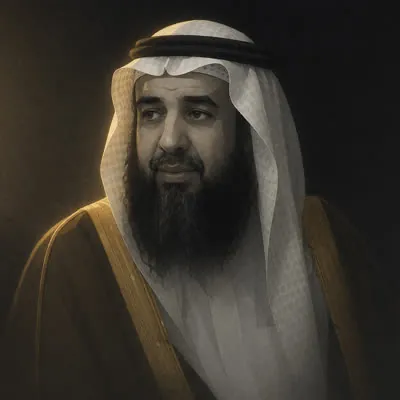
An Islamic lesson by Sheikh Sulayman ar-Ruhaily opening with 'In Allah's name, the Most Merciful' and praise to Allah, Lord of the worlds.
In Allah's name, the Most Merciful, the Compassionate.
Praise be to Allah, Lord of the worlds.
And I bear witness that there is no deity but Allah alone, no partner.
And I bear witness that our Prophet Muhammad ﷺ is His servant and Messenger.
With many more salutations until the Day of Judgment.
We meet again, my beloved in Allah.
in this lofty seat of learning, in this blessed course.
which is organized by Umm al-Mu'minin Association.
under the generous patronage of the International Charity Organization.
as part of the "Reflect on His Verses" course series.
under the title: Reflections on Surat al-Kahf.
by our esteemed Shaykh, Prof. Dr. Sulayman al-Ruhayli HA.
and bless him with health and well-being.
A teacher at the Noble Prophet's Mosque.
and imam and preacher of Quba Mosque.
So let our Shaykh kindly proceed to deliver his course.
May he be thanked and rewarded.
May Allah bless you. Peace be upon you, and Allah's mercy and blessings.
All praise is due to Allah, Lord of the worlds.
And the most complete and perfect blessings and peace
Upon the one sent as a mercy to the worlds,
and upon all his family and companions. As for what follows:
Indeed, one of the greatest paths to goodness.
And among the signs that Allah ﷻ wants good for His servant
is that a person takes the path of seeking knowledge.
For all knowledge is good.
And the noblest knowledge is what relates to the Book of Allah ﷻ.
And we have already said that full benefit from the Qur'an.
Comes through reciting it and pondering its meanings.
And acting upon what it contains.
So whoever Allah ﷻ grants success to recite His Book.
And to ponder its meanings, and act upon what is in it.
Then He has granted him success to fully benefit from the Qur'an.
And the one who competes in good deeds strives to complete the matter.
He also strives to be at the front of the caravan.
For he races to his Lord ﷻ.
We have already mentioned that reflecting on the Quran has two ways.
The first method is overall reflection.
This is based on knowing the surah's overall objectives.
It also rests on knowing its theme and its overall topics.
Then you connect the verses to those overall objectives.
You also link them to the overall topics and derive guidance.
The second method is partial reflection.
That is by reflecting on each verse.
This too, according to the scholars, is of two types.
The first type is reflecting on the verse's guidance.
So reflection focuses on the guidance.
It is based on what the verse indicates.
The second type is reflecting on the verse's meanings.
So reflection focuses on knowing the meaning.
I mentioned that I am keen for this course to be...
a practical application of this and practical training in it.
Because many people want to reflect, but do not do it well.
So if we know these two methods.
and know the two types of the second method.
and train ourselves to do so.
then the path to Quran reflection will be set straight for us.
And yesterday, we covered.
some points in the overall reflection on Surah Al-Kahf.
Then we began partial reflection by reflecting on its guidance.
And we covered five points on this.
The sixth point: all worldly things.
wealth, power, and status, and the like are passing adornment.
The Hereafter is lasting, abiding bliss.
Allah ﷻ says in verses seven and eight.
"Indeed, We have made what is on the earth adornment for it."
"that We may test them as to which of them is best in deed."
"And indeed, We will make what is on it a barren plain."
Meaning: We will make it.
What is on the earth will be wiped out, uprooted from its very root.
So whatever is on it perishes and is destroyed.
And sa'id is the earth's surface.
As for juruz, some scholars said.
It is land with no vegetation.
It is land with no vegetation.
And some scholars said juruz means that which is uprooted.
It is cut off, or what is on it has been eaten.
There is no objection to both meanings.
There is no objection to both meanings.
The successful one is he who knows the worth of this world.
And the Hereafter has its virtue.
And he kept company with this world like a worshipper, fasting and praying.
The deluded one is he whom this world has engrossed.
He kept company with it like cattle, and clung to it like a lovesick man.
The successful among Allah's servants knows the worth of this world.
He enjoys what Allah made lawful from it, not attaching his heart to it.
Rather, he attaches his heart to the Hereafter.
So he makes use of this world in fasting and night prayer.
And by worshiping the Most Merciful ﷻ.
The seventh point: Allah's protection of His close servants.
Whoever is mindful of Allah, Allah ﷻ will preserve him.
Whoever guards Allah's religion, Allah ﷻ will preserve him.
By Allah, however the schemers plot against him.
And however many his opponents are, he is preserved by Allah's protection.
Nothing happens to him except that there is good in it for him.
Whoever draws near to Allah through His obligations.
and whatever voluntary deeds he can, Allah preserves and guides him.
When the People of the Cave withdrew from their people.
fleeing for their tawhid and for their religion.
Allah preserved them wondrously.
He preserved their bodies in their place.
The cave entrance faced a wondrous direction.
So the sun did not enter it throughout the whole time.
So its heat did not harm them.
Rather, at sunrise, the sun inclined away from their cave.
That is, it inclines away from their cave toward the right.
And when it sets, it strikes them.
That is, it strikes their bodies according to the stronger scholarly view.
Because some exegetes explained the word differently.
Like the sun turning away from them meaning it inclines away from them.
But the stronger view is that at sunset it strikes their bodies.
So they could benefit from it.
And despite that, they were in a spacious place.
Inside the cave, shaded and airy.
This was Allah's protection for them: His protection of their bodies there.
And Allah ﷻ also kept turning them to the right and to the left.
Though they were asleep, Allah kept turning them.
So the earth would not consume their bodies.
So blood would keep circulating in their bodies. It had two benefits.
The first benefit was so the earth would not consume the body touching it.
For if it remained.
The body remaining on the ground, the earth would eat it from that side.
The second reason is so that blood keeps circulating in their bodies.
For if they stayed on one side for all that time.
the upper part of their bodies would be drained of blood.
And blood is life for the body.
This is what modern medicine has discovered.
in preserving the bodies of the unconscious.
This concerns preserving their bodies by place and by what was done.
And He protected them from their enemies and predatory animals.
For they were in a cave on a mountain, where predatory animals could reach them.
So He protected them by two great means.
The first was that He placed terror in their appearance.
for whoever looked at them, and it terrified him.
So he would not try to reach them, since whoever looked at them.
You would think them awake.
This was because their eyes were open, while they slept in that state.
Moreover, Allah cast awe upon them.
If anyone looked upon them, he would flee in terror.
nor even think of entering the cave.
And secondly, He made their dog sleep as they did.
And this is the preferred view among the commentators.
Namely, it slept like them for that long period.
But it seemed awake and alert.
It had its forelegs outstretched at the entrance.
as an alert guard dog does.
And it was said al-wasid means the cave entrance.
So in that posture it was by the cave entrance.
And it was also said al-wasid means the side of their courtyard.
In this there was protection for them from enemies.
For if an enemy or a wild beast came near them and saw the dog.
Seeing it in that posture would alarm him.
and frighten him. Glory be to Him who protects His allies.
Allah ﷻ—how can one who obeys Him fear an enemy opposing him for it?
If you obey Allah, be secure.
Allah will bring you only good.
Allah ﷻ says.
“And you would see the sun, when it rose, veer right of their cave.
And when it set, it passed them by on the left.
While they were in an open space within it.
That was from the signs of Allah. Whomever Allah guides is guided.
And whomever He leaves astray, you will find no protecting guide.”
“And you would think them awake, though they were asleep.
And We turned them to the right and to the left.
And their dog stretched out its forelegs at the entrance.
Had you looked upon them, you would have fled from them.
And been filled with terror of them.”
So be with Allah. Be with Allah, and do not worry.
Please Allah; do not fear. Be mindful of Allah; He will guard you.
From this, a medical benefit is derived.
It is that sunlight on the human body in the evening at sunset is better.
And less harmful than earlier exposure.
Because for the People of the Cave, the sun turns away at sunrise.
It does not strike them, but stays around them, benefiting them.
Before sunset, it strikes their bodies. Per the stronger view among commentators.
Our Shaykh, Shaykh Ibn Uthaymeen RH, was among those who preferred this.
So a person's benefit from the sun is that it be around him.
And that it enter his place throughout the day.
When possible.
And that it strike his body near sunset.
Meaning: before sunset, at the end of the day.
The eighth point.
It is not worship to leave the good things of worldly life.
It is not worship to forgo the good things of worldly life.
And there is no blame on one who chooses the best for himself.
The best worldly things, without extravagance or arrogance.
Blame lies only in extravagance and arrogance.
So whoever is free from extravagance and arrogance.
There is no blame on him for choosing the best worldly things.
So he chooses, from every lawful thing, the purest and best for him.
In clothing, in food, in transport, and the like.
Allah ﷻ says in verse nineteen.
"Your Lord knows best how long you have remained," they said.
"So send one of you with this silver coin of yours to the city."
"Let him see which food is purest."
"Then let him bring you provision from it."
"Let him be discreet, and let no one be aware of you."
The point in Allah ﷻ's words is that they said.
"Let him see which food is purest."
So they wanted the purest food.
This indicates the established and well-settled principle.
Ninth point: The danger of speaking on Allah's religion without knowledge.
Whether by making things lawful or forbidden, or otherwise.
For that is lying about Allah.
It is lying about Allah to know what is lawful and say it is forbidden.
Or to know what is forbidden and call it lawful for personal desire.
More vile still is that a person knows, yet says the opposite of what he knows.
For a desire within himself, or for some worldly matter.
And among lies against Allah is to not know, then speak without knowledge.
So you dare to issue a fatwa and dare to pass judgment.
And say, "This is lawful," though you have no knowledge.
Or you say, "This is unlawful," when you have no knowledge.
as Allah ﷻ said: "And do not say what your tongues falsely assert."
"This is lawful and this is unlawful," to invent falsehood about Allah ﷻ."
And lying about them brings many evils.
The higher the rank of the one lied against, the uglier the lie.
Lying about scholars is not like lying about ordinary people.
So lying about scholars is more unjust and more heinous.
How badly we need, in this time, to establish this principle.
To reiterate it, repeat it, and spread it.
For we live in a time when people find it easy to lie about rulers.
And it is easy to lie about scholars.
In fact, many misguided people think lying about rulers is religion.
They draw near to Allah by lying about those in authority.
Likewise, lying about scholars.
Lying about scholars is by attributing to them what is not in them.
By attributing to them what isn't true.
Or by attributing sayings to them that are not theirs.
Some say, 'This scholar has such and such,' but he is innocent of it.
That is a lie against him. Some do this to push what they want.
They say it is Shaykh Ibn Baz RH's view, though he never said it.
Or they say it is Shaykh al- Albani's or Shaykh Muqbil's view.
Or our senior shaykhs' view, or the like. They did not say it. A lie on them.
How did we derive this point? From Surah al-Kahf.
We derived this from Allah ﷻ's words.
"Who is more unjust than one who fabricates a lie about Allah ﷻ?"
Shaykh Ibn Uthaymin RH said.
If you lied about a person, that would be injustice.
Lying about any human being is injustice.
And if it were about someone higher than him.
That would be more unjust than the first.
So if you invent a lie against Allah ﷻ, none is more unjust.
The shaykh derived this from the fact that it is lying about Allah ﷻ.
It is the worst fabrication and the gravest lie.
So he says: the higher the person's rank, the greater the injustice.
So the most unjust and gravest lie is lying about Allah ﷻ.
This is very useful.
The eleventh point: We believe and are certain.
Allah willed and decreed that some people are guided.
And some are astray.
And all of Allah's judgment is just.
For Allah does not wrong people in the least.
By Allah, then by Allah, then by Allah.
If Allah ﷻ punished all people, He would not be unjust to them.
So His decreeing that one goes astray contains no injustice.
Brothers, this is one of the most beneficial rules of divine decree.
Be certain that Allah does not wrong people at all.
Understand divine decree in light of this rule.
Allah ﷻ does not wrong people in the least.
Therefore, though we are certain that Allah willed and decreed.
Some people are guided, and some are astray.
We are certain there is no injustice in it.
And we are certain there is wisdom in it.
And we are content with Allah's decree, content with Allah's decree.
Yet despite that, what is required of us by the Sharia.
is that we enjoin good properly.
and forbid evil without doing evil.
This is a fine guideline for enjoining good and forbidding evil.
Enjoining good must be done properly.
And forbidding evil must not be evil.
This is required of us by the Sharia, while we remain certain.
that Allah willed whoever went astray to stray.
that we enjoin good and forbid evil.
and strive to guide whoever we see astray to guidance.
For we do not know what was decreed for him: remain astray or be guided?
So our duty is to strive.
to guide whoever we see astray to the path of guidance.
Allah Most High said in verse seventeen.
"Whoever Allah guides is rightly guided."
"But whoever He leaves astray, you will never find him a guiding ally."
Scholars also derived from this.
That guidance is sought only from Allah.
By turning to Allah's Book.
And to the Sunnah of Allah's Messenger ﷺ and supplication.
Whoever wants guidance must do this.
He must turn to the Quran and be guided by what is in it.
And turn to the Sunnah of the master of Adnan's offspring ﷺ.
And be guided by it, and increase in supplication and humility,
Asking Allah ﷻ to guide him.
The twelfth point.
The sleeper has no action.
And he is not held accountable for any deed or speech.
Brothers, no action is attributed to the sleeper.
Nor is any speech attributed to him.
Nor is he held accountable for word or deed.
For example, if a woman spoke while asleep beside her husband.
that she loved a certain man.
A man may be asleep beside his wife, or awake as she sleeps.
and she says she loves so-and-so, and he hears it.
then he has no right to attribute that to her.
Nor may he hold her accountable for it.
And if a man divorced in his sleep, even mentioning his wife's name.
If, while asleep, he kept saying, "So-and-so is divorced."
his divorce does not count, by scholarly consensus.
Even if he admitted something against himself.
He is not held accountable for it. That is not even evidence.
For example, brothers, if a person was sued in court.
that he owed such-and-such. Then he fell asleep.
Asleep, he admitted someone was owed such-and-such; a thousand heard.
He is not held accountable for that admission; his words are void.
Allah ﷻ said: "And We turned them."
So the act is not attributed to them, nor was it, for they slept.
The One who turns them is Allah ﷻ, by His command ﷻ.
That shows this great principle.
The thirteenth reflection.
It is prudent and wise
for a person to be keen on concealment when afraid.
As when he fears an enemy or an envier.
That also includes fear of the evil eye.
For that is wisdom and prudence, indeed what the religion requires.
A person should keep it hidden and not spread it.
Allah ﷻ said in verses nineteen and twenty.
"So let him be careful, and let no one be aware of you."
"Indeed, if they learn of you, they will stone you."
Or return you to their religion, and never will you succeed—ever."
So, when these youths feared for their religion.
and for themselves when they awoke, they sent their agent.
to buy with their silver coins the purest food for them.
that he finds. They said, Let him be discreet.
Be discreet means: keep hidden and act secretly.
so that the enemies do not discover him.
Believers are wisely instructed to keep things concealed when afraid.
How greatly we need to grasp this principle in this age.
when publicizing blessings to everyone without benefit is common.
We find many women and many men.
who photograph what is in their homes and photograph their children.
and photograph their car and post it for all to see.
And people are not all the same.
Rather, some of them are envious. And the envier casts the evil eye.
And some are admirers who do not mention Allah ﷻ when amazed.
Admiration without mentioning Allah ﷻ.
causes affliction by the evil eye.
How many people have brought affliction upon themselves.
and upon their offspring and their families as well.
because of failing to hide it and spreading such things.
with no sound benefit sought by sensible people. And I said.
Many times over, it is not permissible for a father.
or a mother to photograph a son or a daughter.
and post it before everyone.
Because in reality, this leads to two harms, or one of them.
One harm is bringing the evil eye. And the evil eye is real and severe.
We know this from many stories about it in real life.
The second harm is that one may photograph a boy or girl in a funny pose.
or in a degrading pose and post it.
to get likes.
Then the child grows up, and that posted image stays and harms him.
later in life, when he understands. This is not permissible.
Children are a trust with us.
Parents must do what is best for children.
Parents' guardianship over children is not based on personal whim.
Rather, it is a guardianship that requires the best to be done.
I have said repeatedly that one part of this is choosing names.
So neither father nor mother should choose a name just to please themselves.
Rather, they should consider the child's best interest.
Is this name suitable for him?
that will not harm him or expose him to ridicule, and such.
This is one result of this point.
I mean that parents must fear Allah in how they deal with children.
and be certain their duty is to do what is best and avoid wrongdoing.
The fourteenth reflection.
A seeker of knowledge—indeed any Muslim in general.
should not dispute or argue except with knowledge.
And only where there is benefit.
If not, he remains silent. This is the Sharia standard.
A seeker of knowledge does not argue in scholarly matters.
Nor does he dispute except with knowledge.
provided such argument offers some hoped-for benefit.
Whether that benefit occurs is known to Allah.
But there should be hoped-for benefit.
And likewise any Muslim. Even in worldly matters.
does not dispute, argue, or discuss except with knowledge.
And where there is benefit. Otherwise, he remains silent.
This is also included in the saying of the Prophet ﷺ.
“Whoever believes in Allah ﷻ and the Last Day, let him speak good.”
“or let him be silent.” Let him speak good, or be silent.
This is the universal legal rule for speech.
Weigh it before you speak. If it is good, then speak.
Otherwise, the default is silence.
Allah ﷻ says in verse 22.
“Say, ‘My Lord knows best their number; only a few know them.’
“So do not argue about them except with clear argument.”
“And do not ask anyone among them about them.”
Meaning: do not argue about them.
Except with argument based on knowledge.
And there should also be benefit in it.
The fifteenth point is connected to this.
Avoiding argument about what is unnecessary
or has no great benefit in it. That brings hearts together more.
It is more restful for souls and better for life.
A person who argues over everything without any standard troubles himself.
It brings worries into his heart and ruins his life as well.
Most people's anxiety and problems come from needless argument.
Or from persisting in needless arguments.
No benefit warrants it, even in the home.
Sometimes a husband opens a topic for discussion with his wife.
There is no need for it. So the outcome is discord.
Sometimes there is an argument over something beneficial.
Then one goes too far in it.
One goes too far in what stems from it until it leads to ruin.
How many, many wives have made themselves and their husbands miserable.
By entering a needless discussion until life turned bitter.
And many a husband has done the same.
It is better for a person not to argue.
Nor dispute except when needed and only as much as needed.
provided its benefit is clear.
If no benefit is clear, it is left.
How beautiful this is! Yes, it is ideal, but possible.
Applying it is hard, but possible.
A person can apply it with his brothers and friends.
with his colleagues and his family.
Even if that is difficult.
For it is one of the hardest things for a person.
to hold his tongue back from speaking.
especially when there is some provocation.
But whoever trains himself in something will master it.
For forbearance is acquired by practice.
And this is a great, precious benefit.
The sixteenth point.
Whoever is not known for knowledge based on evidence.
Such a person should not be turned to or asked for fatwas.
Even if his speech is beautiful and impresses people.
Some people appear on television and speak for an hour.
His speech may be beautiful and impress the viewers.
But you do not know him for knowledge nor find knowledge in his words.
Rather, in most cases it produces only doubt.
And he says many evil things. This is a clear reality.
Someone like this should not be consulted.
Nor may fatwas be sought from him.
Allah ﷻ said: "Do not ask any of them about them."
And 'anyone' here is indefinite in a prohibition, so it is general.
So whoever is not known for knowledge, nor learning from scholars.
Nor for adhering to evidence.
So it is not permissible to refer to him in the religion of Allah ﷻ.
The seventeenth point: The servant's future actions.
If actual occurrence is intended.
They must be ascribed to Allah's will.
A servant's future actions, if occurrence is intended.
It must necessarily be ascribed to Allah's will.
For it is unseen, hidden from the servant.
It may happen, and it may not happen.
By Allah's will, matters are eased.
Matters are eased, and blessing is attained.
When saying it, he recalls his reliance on Allah and seeking His aid.
Why say 'If Allah wills' about future acts meant to occur?
First: ascribing the matter to Allah, because occurrence is unseen.
And the servant does not know if it will happen or not.
Second: by mentioning Allah's will.
The good a person wants is facilitated.
Third: mentioning Allah's will brings blessing.
Fourth: mentioning Allah's will is a reminder.
To rely on Allah in this act.
And to seek help from Allah ﷻ in this act.
This is if actual occurrence is intended.
Pay attention: this is a very valuable fiqh and scholarly point.
But if it is meant to report what a person has resolved upon.
That he is informing of his resolve. Not of actual occurrence.
then it is not necessary to qualify it with Allah's will.
because the resolve already exists.
The resolve exists now. As if someone said to you.
Will you visit me tomorrow?
while you are determined to visit him tomorrow.
and you want to tell him of your resolve.
You need not say, "I'll visit you tomorrow, if Allah wills." Not required.
Rather, you may say, "I'll visit you tomorrow, if Allah wills."
And you may say, "I'll visit you tomorrow."
Because you are now speaking of your intent, not its occurrence.
If your purpose is to speak of the resolve you now have.
to let your listener know that you intend it.
then you need not link the act to Allah's will.
But if your purpose is to speak of its actual occurrence.
then it must necessarily be tied to Allah's will.
Because you do not know what will happen and what will not.
If we know the reason for requiring mention of Allah's will.
when speaking with intent that it will happen.
It is that this is unseen, not yet occurring now.
And Allah knows whether it will happen or not.
And the reason.
The reason it is not required to qualify the act with 'if Allah wills'.
when speaking of one's intention.
Because the intention exists now.
So you are speaking of a reality and of something present.
Our shaykh, Shaykh Ibn Uthaymeen RH
in his Tafsir of Surah al-Kahf. Allah ﷻ said.
“Never say of anything, ‘I will do that tomorrow.’”
“except if Allah wills.” “And remember your Lord when you forget.”
“And say, ‘Perhaps my Lord will guide me to better guidance than this.’”
The eighteenth point.
Remembering Allah is a cure for forgetfulness and dispels it.
Thus, one cure for forgetfulness is remembering Allah often.
And reading the Qur'an often.
Whoever complains of frequent forgetfulness should remember Allah often.
And recite the Quran often.
For this clears the mind.
And drives away forgetfulness.
Therefore, O brothers, this is part of the wisdom of the Sharia.
It was prescribed for the follower.
If the imam forgets, say, 'Subhan Allah.'
It is prescribed for the follower if the imam forgets, to say Subhan Allah.
Why was this very phrase prescribed?
Because 'Subhan Allah' is among the highest and noblest remembrance.
That may be a reason for the imam to remember.
Meaning: the follower's 'Subhan Allah' alerts the imam that he forgot.
This remembrance may cause the imam to notice exactly what he forgot.
Because remembrance of Allah dispels forgetfulness.
As Allah said, as we heard: "And remember your Lord when you forget."
"And say, 'Perhaps my Lord will guide me to what is nearer to guidance than this.'"
Perhaps we should stop at this point to keep to the allotted time.
And we will continue after Maghrib prayer, if Allah wills.
And the brothers are requested to be keen to attend after prayer.
so that we may make the most of the time. May Allah bless everyone.