Explaining Al-Da'i ila Khayr al-Masa'i by Sheikh Salih Al-Usaymi
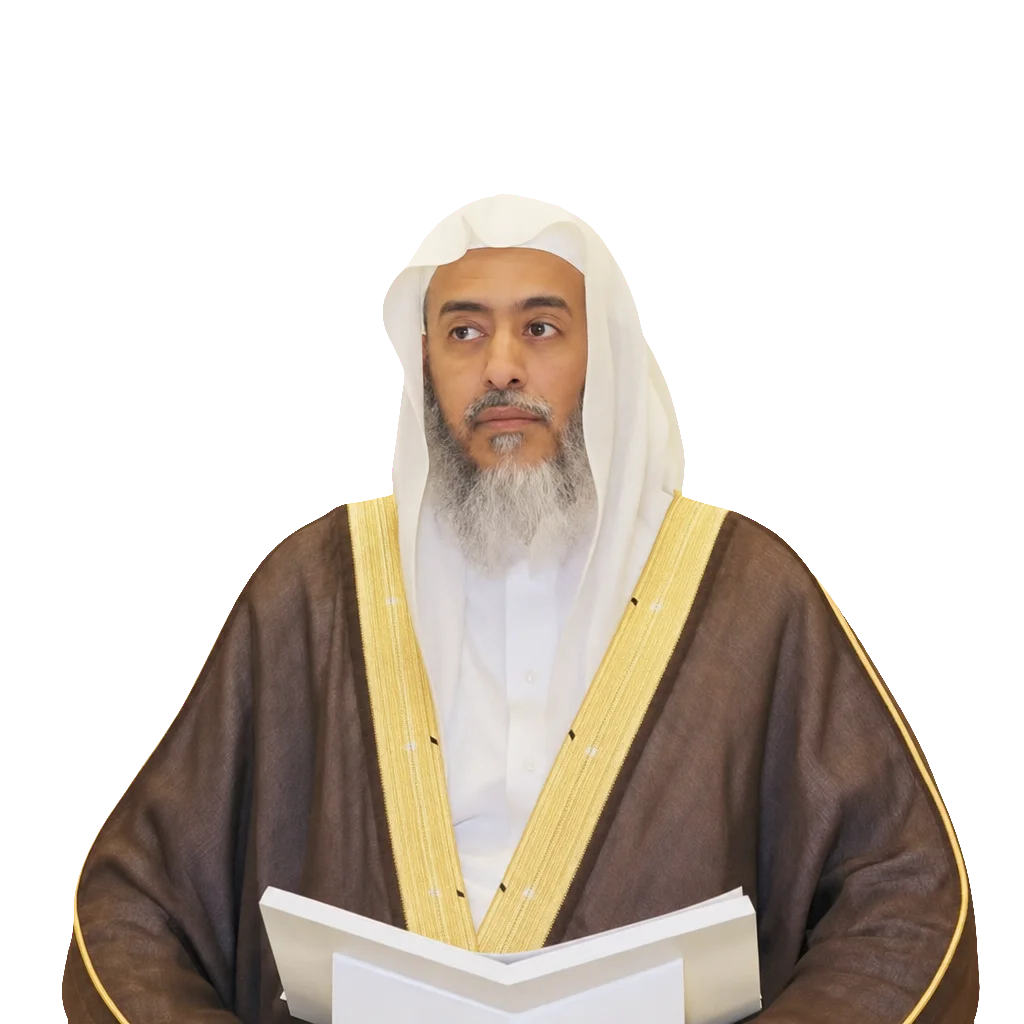
In this first session explaining his book Al-Da'i ila Khayr al-Masa'i, Sheikh Salih Al-Usaymi discusses the primacy of Tawhid as the greatest command of Allah ﷻ and the severity of Shirk as the greatest prohibition. He highlights the obligation of learning Tawhid and the necessity of striving for sincerity.
Peace be upon you and the mercy of Allah and His blessings.
Praise be to Allah ﷻ, Lord of the worlds, Lord of the heavens, earth, and the Great Throne.
I bear witness that there is no deity except Allah ﷻ alone, without partner, truly worshipped.
And I bear witness that Muhammad ﷺ is His servant and Messenger, conveying the truth.
May Allah ﷻ bless him, his family, and all his companions,
and those who follow them in righteousness until the Day of Judgment.
To proceed:
This is the first session in explaining the book "Al-Da'i ila Khayr al-Masa'i"
by its author, Salih bin Abdullah bin Hamad Al-Usaymi.
Yes.
“In the name of Allāh, the Entirely Merciful, the Especially Merciful.”
“[All] praise is [due] to Allāh, Lord of the worlds -” (Quran 1:1-2)
May Allah send blessings and peace upon Muhammad, his family, and his companions.
To proceed: Know that the greatest thing Allah has commanded is Tawhid,
and the greatest thing He has forbidden is Shirk. Allah ﷻ said:
“Worship Allāh and associate nothing with Him, and to parents do good, and to relatives, orphans, the needy, the near neighbor, the neighbor farther away, the companion at your side, the traveler, and those whom your right hands possess. Indeed, Allāh does not like those who are self-deluding and boastful,” (Quran 4:36)
...anything [with Him]."
He has commanded us to learn Tawhid, so He, the Most High, said:
“So know, [O Muḥammad], that there is no deity except Allāh and ask forgiveness for your sin and for the believing men and believing women. And Allāh knows of your movement and your resting place.” (Quran 47:19)
and believing women."
It is the first obligation upon the servant, begun before all other commands, even prayer.
For when the Prophet ﷺ sent Mu'adh bin Jabal (RA)—
to the people of Yemen,
he said to him, "You are going to a people from the People of the Book,"
"so let the first thing you invite them to be to single out Allah the Almighty in worship."
"And when they know that,
tell them that Allah has obligated upon them five prayers in their day and night."
Agreed upon, from the Hadith of 'Abdullah bin 'Abbas (RA).
And the servant must fear Shirk,
for it is most feared by those who know their Lord and know its evil consequence.
And consider the supplication of Al-Khalil (AS)—and he is who he is—
that Allah keep him and his sons away from worshipping idols.
So what about anyone else?
Ibrahim al-Taymi (RH) said:
"Who can feel safe from trial after the Close Friend of Allah, Ibrahim (AS),"
when he says:
“And [mention, O Muḥammad], when Abraham said, "My Lord, make this city [i.e., Makkah] secure and keep me and my sons away from worshipping idols.” (Quran 14:35)
Narrated by al-Bukhari.
The author, may Allah grant him success, began his book with the Basmalah,
then followed it with the praise of Allah,
and thirdly, with sending blessings and peace upon Muhammad ﷺ
and upon his family and companions.
These three are by consensus among the etiquettes of authorship.
So, whoever writes a book, it is recommended for him to open it with them.
Then he proceeded to call to one of the best of endeavors,
saying: "Know that the greatest of what Allah has commanded is Tawhid,
and the greatest of what He has forbidden is Shirk."
For indeed, the legislated commands are of various levels.
Good deeds have differing ranks;
some of them are obligatory, and some are supererogatory.
The obligation itself has differing ranks, and likewise the supererogatory.
And just as it is said of the commands, it is said of the prohibitions.
For indeed, the prohibitions are also of differing ranks.
The levels of bad deeds vary; among them are...
...major ones, and among them are minor ones,
and each of the two types has varying degrees.
And these commands and prohibitions,
even if they share the same basis of command and prohibition,
one of them is prioritized as the greatest.
The greatest of commands is the Tawheed of Allah ﷻ,
and the greatest of prohibitions is shirk with Him.
The author mentioned the evidence, saying: Allah ﷻ said,
“Worship Allāh and associate nothing with Him, and to parents do good, and to relatives, orphans, the needy, the near neighbor, the neighbor farther away, the companion at your side, the traveler, and those whom your right hands possess. Indeed, Allāh does not like those who are self-deluding and boastful,” (Quran 4:36)
...anything."
The mentioned verse indicates that the greatest of commands...
...is Tawheed, and the greatest of prohibitions is Shirk.
And its indication of that is from two aspects:
First: in prioritizing the command of Tawheed and the prohibition of Shirk
over what comes after them of the commands and prohibitions
in the verse: the prioritization of the command of Tawheed and the prohibition of Shirk
over what comes after them of the commands
and prohibitions in the verse. And what is prioritized
So the verse opening with the command of Tawheed indicates it is the greatest of commands.
And the verse opening its prohibition with the prohibition of Shirk indicates it is the greatest of prohibitions.
The second: in the conjunction of what comes after them — of the commands and prohibitions — to them;
in the conjunction of what comes after them of the commands and prohibitions to them.
For indeed, the commands mentioned in the verse are conjoined to the command of Tawheed,
and the prohibitions mentioned in the verse are conjoined to the prohibition of Shirk,
Conjunction is a type of appositive (tābiʿ) in the Arabic language,
Grammarians mention four appositives: description (naʿt), emphasis (tawkīd), substitution (badal), and conjunction (ʿaṭf).
And just as this exists in language, it also exists in meanings.
So what is made subordinate in the commands and prohibitions in the verse
is in the position of being lower in rank than what was put first.
The first of the commands is the command of Tawhid,
and the subsequent commands are subordinate to it.
Likewise, the first of the prohibitions is the prohibition of Shirk,
and the subsequent prohibitions are subordinate to it.
Then he said: "We have been commanded to learn Tawhid, as Allah ﷻ says:"
“So know, [O Muḥammad], that there is no deity except Allāh and ask forgiveness for your sin and for the believing men and believing women. And Allāh knows of your movement and your resting place.” (Quran 47:19)
—the verse.
And the indication of the verse for the command to learn Tawheed is in His saying:
“So know, [O Muḥammad], that there is no deity except Allāh and ask forgiveness for your sin and for the believing men and believing women. And Allāh knows of your movement and your resting place.” (Quran 47:19)
For it is a command to the Prophet ﷺ
to learn the Tawheed mentioned by the statement indicating it.
For "la ilaha illa Allah" is the statement of Tawheed,
so the statement of Tawheed was made to indicate the signified, which is its meaning.
Thus, the meaning of the speech is: "Know Tawheed."
So that which indicates was put in place of that which is indicated.
And the mentioned verse is from a Madani Surah, which is Surah Muhammad,
It was revealed to the Prophet ﷺ
after the efforts he made in calling to Tawheed in Makkah.
For he made every effort, repeatedly calling people to Tawheed in Makkah,
and he stayed among the main body of Quraysh for thirteen years,
calling them to the Tawheed of Allah. Then, when he migrated to...
Al-Madinah, among what was revealed to him ﷺ
was His command to know Tawhid, in His saying:
“So know, [O Muḥammad], that there is no deity except Allāh and ask forgiveness for your sin and for the believing men and believing women. And Allāh knows of your movement and your resting place.” (Quran 47:19)
So if the one who establishes Tawheed best by calling to it
is commanded to learn Tawheed,
then the rest of creation
is even more duty-bound to be eager for this, being commanded with it.
And among the principles of Sharia discourse is that the command and prohibition which
the Prophet ﷺ was directly addressed with in the Quran
is greater than for anyone else. Thus, the statement of Allah Almighty: "O Prophet,"
"fear Allah," or His statement...
“So be patient, [O Muḥammad], as were those of determination among the messengers and do not be impatient for them. It will be - on the Day they see that which they are promised - as though they had not remained [in the world] except an hour of a day. [This is] notification. And will [any] be destroyed except the defiantly disobedient people?” (Quran 46:35)
or His saying, Exalted is He: "Establish prayer," indicates
that addressing him ﷺ first by directing it to him
shows that what is mentioned is among the greatest of commandments.
Likewise is the case with this verse from Surah Muhammad ﷺ,
as His commanding him to learn Tawheed is the greatest of commandments.
Then he said: "And it," meaning Tawheed,
is the first obligation upon the servant; meaning, the first thing
that becomes binding upon the servant as an obligation.
And Tawheed being the first obligation upon the servant has two aspects:
one of which is that this
priority is absolute.
This absolute priority
applies to a disbeliever when they enter Islam.
This is in the case of a disbeliever when they enter Islam,
for they are commanded with the word of Tawheed: "There is no deity worthy of worship except Allah."
He is commanded with the word of Tawheed: 'La ilaha illa Allah'.
And the second is that the priority is ruling-based,
in the case of someone who grew up adhering to the religion of Islam.
Regarding the priority being ruling-based,
this is in the case of someone who grew up adhering to the religion of Islam.
So whoever is born to Muslim parents is required to have Tawheed first,
for none of the acts of worship he is commanded with—the first of which is prayer—
and its prerequisite, wudu, are valid until he is a muwahhid.
Whoever understands these two cases will know the difference between them,
and that the priority whose obligation the scholars mention
in Tawheed differs between a servant who was a disbeliever and accepted Islam,
and a servant who originally adheres to Islam by virtue of being born to Muslim parents.
For the first, the priority is real, manifest, and clear,
since he does not enter the religion of Islam until he utters the word of Tawheed.
As for the second, the priority in it is ruling-based,
considering that the very first Sharia obligation binding upon him is the Tawhid of Allah ﷻ.
For the prayer that he is commanded to perform at the age of seven is not valid, along with its prerequisite,
which is wudu, until he is a muwahhid of Allah ﷻ.
Once these two aspects are understood, the problem is resolved regarding the scholars
declaring the first obligation, even for one who already believes in the religion of Islam.
For their application of it to one who believes in the religion of Islam is due to the meaning we mentioned,
namely, that the priority in this case is ruling-based.
Among the methods of the Salaf in raising the youth is that they preferred,
that when a boy or girl first begins to speak, they should be taught: "La ilaha illa Allah."
When the tongue of a boy or girl begins to speak, they should be taught 'La ilaha illa Allah'.
so that his heart absorbs the reality of Tawhid
through its declaration, becoming one who submits to Allah in Islam,
born to Muslim parents, with firm belief.
“So know, [O Muḥammad], that there is no deity except Allāh and ask forgiveness for your sin and for the believing men and believing women. And Allāh knows of your movement and your resting place.” (Quran 47:19)
Then he said: "And it is started with before other commands,"
even prayer.' That is, the command of Tawhid is prioritized
over the command of any other obligation, no matter its status,
even if the commanded act is prayer, which is the greatest of the practical pillars.
For Tawhid is greater than it.
The evidence for this is: "For when the Prophet ﷺ sent Mu'adh ibn Jabal (RA)
to the people of Yemen, he said to him,
'You are going to a people from the People of the Book,
so let the first thing you call them to be to single out Allah Almighty in worship.' The Hadith.
It is agreed upon, from the Hadith of 'Abdullah ibn 'Abbas (RA), and the wording is Al-Bukhari's.
This mentioned Hadith indicates starting the call to Tawhid and commanding it before...
anything else, in two ways.
First, in his saying: "Let the first thing to which you invite them be to assert the Oneness of Allah ﷻ,"
thus making the priority of the call exclusive to calling them to the Oneness of Allah ﷻ.
And the second is in delaying the command
to pray after calling them to Tawhid,
in his saying: "If they acknowledge that,
then inform them that Allah ﷻ has enjoined upon them five prayers in their day and night."
Then he said: "And the servant must fear Shirk,
for it is the most feared thing for whoever knows its ugliness and evil consequence,"
for the safety of a servant's religion lies in his constant fear of Shirk,
and that the servant should fear it. For whoever knows the ugliness of Shirk,
and that it involves insulting Allah ﷻ, detracting from Him, and undermining His right,
and giving what belongs to Him to someone else, knows the heinousness and ugliness of Shirk.
For a person finds it abominable that a right belonging to one of the creation be directed to someone else.
If it were assumed that someone laid hands on something owned by another creation,
by force and coercion, then gave it to another, his action would be deemed unjust.
How then if this is the action of a slave owned by Allah ﷻ,
in that he gives Allah's ﷻ right of worship to someone else?
And because of its heinousness, Allah ﷻ does not forgive it. He, the Exalted, said:
“Indeed, Allāh does not forgive association with Him, but He forgives what is less than that for whom He wills. And he who associates others with Allāh has certainly fabricated a tremendous sin.” (Quran 4:48)
...the verse.
The source of intense fear of Shirk stems from two matters.
The source of intense fear of Shirk stems from two matters:
The first: its inherent ugliness in itself.
Its inherent ugliness in itself —
that it involves assigning the right of Allah ﷻ to other than Him.
That it involves assigning the right of Allah ﷻ to other than Him.
The second: its evil consequence — that the servant will not be forgiven for it.
Its evil consequence — that the servant will not be forgiven for whatever Shirk he fell into.
For every sin there is hope of forgiveness, except shirk.
Every sin carries hope of forgiveness, except shirk.
Then he said,
with concern: "Take heed from the supplication of al-Khalil —"
meaning Ibrahim (AS) —
"and he is who he is" — meaning, at what level
of realizing Tawhid, as Allah ﷻ said: "Indeed, Ibrahim..."
“Indeed, Abraham was a [comprehensive] leader, devoutly obedient to Allāh, inclining toward truth, and he was not of those who associate others with Allāh.” (Quran 16:120)
So despite Ibrahim al-Khalil (AS)
reaching this lofty station of realizing Tawhid,
he supplicated to his Lord, Glory be to Him, to keep him and his sons away from the worship of idols.
The state that came upon Ibrahim al-Khalil (AS)
in his intense fear of shirk —
despite being one who had realized Tawhid and reached the station of Khullah —
should cause others to fear it even more intensely.
And this fear is evident in the state of Ibrahim (AS) from two aspects.
This fear is evident in the state of Ibrahim (AS) from two aspects: the first is in his supplication to Allah ﷻ
to keep him and his
sons away from shirk.
And supplication for protection is made regarding what one fears and is wary of.
Supplication for protection is made regarding what one fears and is wary of.
For when a person fears something, he supplicates to Allah to keep him away from it.
For if a person fears something, he supplicates to Allah to keep him away from it.
So, supplicating to be kept away from worshipping idols indicates that this worship,
which is Shirk, is something a servant should fear.
And the other aspect is that the one
supplicating for this is Ibrahim (AS),
who realized Tawhid completely until he became the Khalil of Allah,
the Lord of the worlds.
So if Ibrahim, being at this status, feared Shirk for himself and his sons,
then others are even more worthy of fearing it.
For this reason, Ibrahim Al-Taymi, one of the Tabi'un, said: "Who can feel safe from trial after the Khalil of Allah,
Ibrahim, when he says: 'And keep me and my sons away from worshipping idols'?"
Narrated by Ibn Jarir in his Tafsir.
Meaning, no one can feel safe from falling into the trial of Shirk after...
Ibrahim (AS), who had realized Tawhid,
then the fear for others is even greater.
So a servant's fear of
shirk should intensify when considering the state of Abraham (AS).
What also drives a servant to fear shirk intensely is the abundance of its gates.
Abdullah ibn Mas'ud (RA) said:
"Shirk has seventy-odd gates."
"Shirk has seventy-odd gates."
Narrated by al-Bazzar and others with a sahih chain.
Mentioning the number seventy in Arabic speech is meant to denote multiplicity,
and "gates" refers to types. Thus, the types of shirk are many,
and when its types are numerous, a servant cannot feel safe
from falling into any of them.
Consider this regarding riya' (showing off), which is one of those gates,
And it knocks on the servant's heart every day.
For the one who performs righteous deeds for Allah ﷻ fears intensely
that some of his deeds might be done out of riya'.
Sahl ibn 'Abdullah and Muhammad ibn Idris al-Shafi'i (RH) said:
"None fear riya' except the sincere ones,"
meaning, none feel the fear of riya' and notice its subtleties
except those striving to achieve the status of sincerity.
May Allah ﷻ make us and you among them.
Yes.